
SEBASTIEN MAHON PAINTING
SEBASTIEN MAHON : « Là où la terre s'achève »
Ces cités extraordinaires, situées là où la terre s'arrête et où commencent les océans, sont inconnues de tout cartographe terrestre. Dans l'art ingénieux de Sébastien Mahon, en effet, la réalité se transmute en Utopie, et la peinture en rêve.
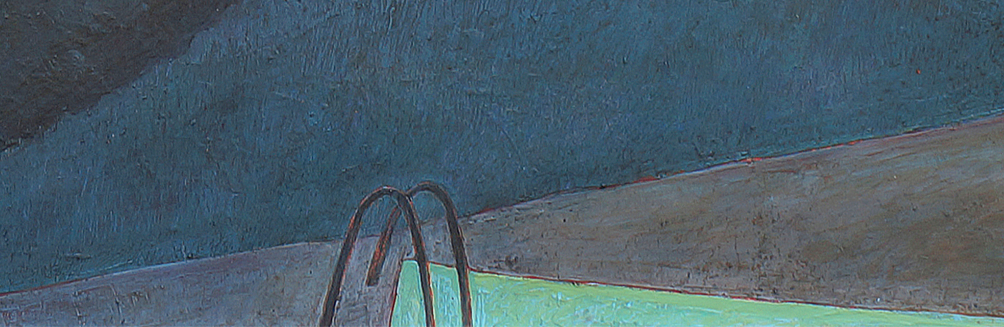
Dans sa série « Glorious Tropical », un déplacement dans le temps et l'espace nous ramène à un autre âge, cet « âge d'or » qui, depuis Hésiode, Ovide et Érasme, hante l'imaginaire des poètes mécontents de leur époque. Le genre pictural, ici, vole en éclats. Peintes à l'huile, mais étonnamment éthérées, les images de Mahon nous happent comme les illustrations d'un livre de contes favori. Le désir évident de raconter apparente son œuvre à la bande dessinée ; sa quête d'un bonheur ingénu évoque l'art naïf (le muralisme) ; son attention à la réalité contemporaine rappelle la peinture américaine*. L'aisance de son « pinceau », combinée à l'aura magique du voyage qui imprègne son travail, crée en outre une atmosphère d'intimité et de nostalgie.
Le mot « nostalgie » a été forgé en 1678 par le médecin suisse J.-J. Harder, à partir du grec nostos, le retour au foyer, et algos, la douleur ou le désir. Dans son Vocabulaire d'esthétique, Étienne Souriau en donne une définition précise qui l'élève au rang de genre esthétique : « La nostalgie devient une véritable forme d'inspiration artistique (…) lorsqu'elle dépasse le niveau de la représentation mentale pour créer une œuvre effective, dans laquelle ce qui est absent est véritablement présent tout en gardant son aura d'Ailleurs. De telles œuvres peuvent exercer sur les spectateurs un effet si puissant qu'ils en viennent à appartenir moralement à une terre jusque-là étrangère. Cet amour des pays lointains ne concerne pas seulement les pays réels : on peut éprouver de la nostalgie pour une terre imaginaire ou mythique, qu'une œuvre d'art peut incarner avec assez de force pour être dispensée d'exister matériellement. »
Toutes les œuvres de Sébastien Mahon portent la marque de cet état émotionnel complexe, personnel et intense, troublant et nourricier, mais toujours précis. Dans ses peintures antérieures, qui portent non sur des lieux lointains mais sur une période que l'artiste ne connaît qu'indirectement, les années 1960, Mahon demande : « Quel est le rapport intrinsèque de la réalité à une époque donnée ? »
L'originalité de ce va-et-vient tient à la matérialisation d'un secret, emprisonné dans une époque et un monde qui lui sont propres, que l'intervention des images transforme en mythologie.
Ileana Cornea.
* Peinture américaine : Richard Diebenkorn, Andrew Wyeth, Peter Doig, Edward Hopper…
Notes :
Americain painting * :Richard Diebenkorn, Peter WYETER, Peter Doig, Edward Hopper…
SEBASTIEN MAHON “Where Land Ceases”
These extra ordinary cities, located where land ceases and oceans begin, are known to no earthly cartographer. Indeed, in the ingenious art of Sébastien Mahon, reality is transmuted into Utopia. And painting into a dream.
In his series entitled “Glorious Tropical”, a shift in time and place takes us back to another age, the “golden age” that since Hesiod, Ovid and Erasmus has haunted the imaginations of poets discontented with their day. The pictorial genre, here, is smashed. Painted in oil, yet surprisingly ethereal, we plunge into Mahon's images like the illustrations of a favorite storybook. The artist's evident desire to narrate likens his work to the comic strip; his pursuit of ingenuous happiness evokes naïve art( muralism); his focus on contemporary reality is reminiscent of American painting * . Mahon's easy “brush” play, furthermore, combined with the magical aura of travel that permeates his work creates an atmosphere of intimacy, of nostalgia.
The word nostalgia word was coined by Swiss doctor J-J Harder in 1678 from the Greek “nostos”, returning home, and “algos”, pain/longing. In his “ Vocabulary of Aesthetics”, Etienne Souriau gives it a specific definition that raises it to an aesthetic genre. “Nostalgia becomes an actual form of artistic inspiration (...) when it moves beyond the level of mental representation in order to create an effective work, in which what is absent is truly present while retaining its aura of Elsewhere. Such works can have such an overpowering effect upon spectators that they are led to belong morally to a hitherto foreign land. This love of far-off places does not only apply to real countries; we are able to feel nostalgia for an imagined or mythical land, which a work of art can so forcefully embody that it is dispensed from existing materially.”
All of Sébastien Mahon's works bear the stamp of this complex emotional state, personal and intense, troubling and nurturing - yet always precise. In earlier paintings, dealing not with faraway places but with a period of time that the artist is only indirectly familiar with, the 1960s, Mahon asks “What is reality's intrinsic relationship to a particular era?”
The originality of this back-and-forth lies in the materialization of a secret - imprisoned in an era and a world of its own - that through the intervention of images is transformed into a mythology.
Ileana Cornea
Amricain painting * :Richard Diebenkorn, Peter WYETER, Peter Doig, Edward Hopper…